The Parent Letter Traffic Light System
General
For a quick overview of the status of a parent letter, we have developed the parent letter traffic light system for you. Here, all information from the various addressees and stages of the messaging process comes together and is simply and clearly visualised.
With the parent letter traffic light system, we inherit the delivery information of the parent letter from bottom (pupil) to top (grade level). This way, you can see at a glance, for example, whether the parent letter has been sent to all selected classes and whether all parent letters could be delivered, as the following example shows:
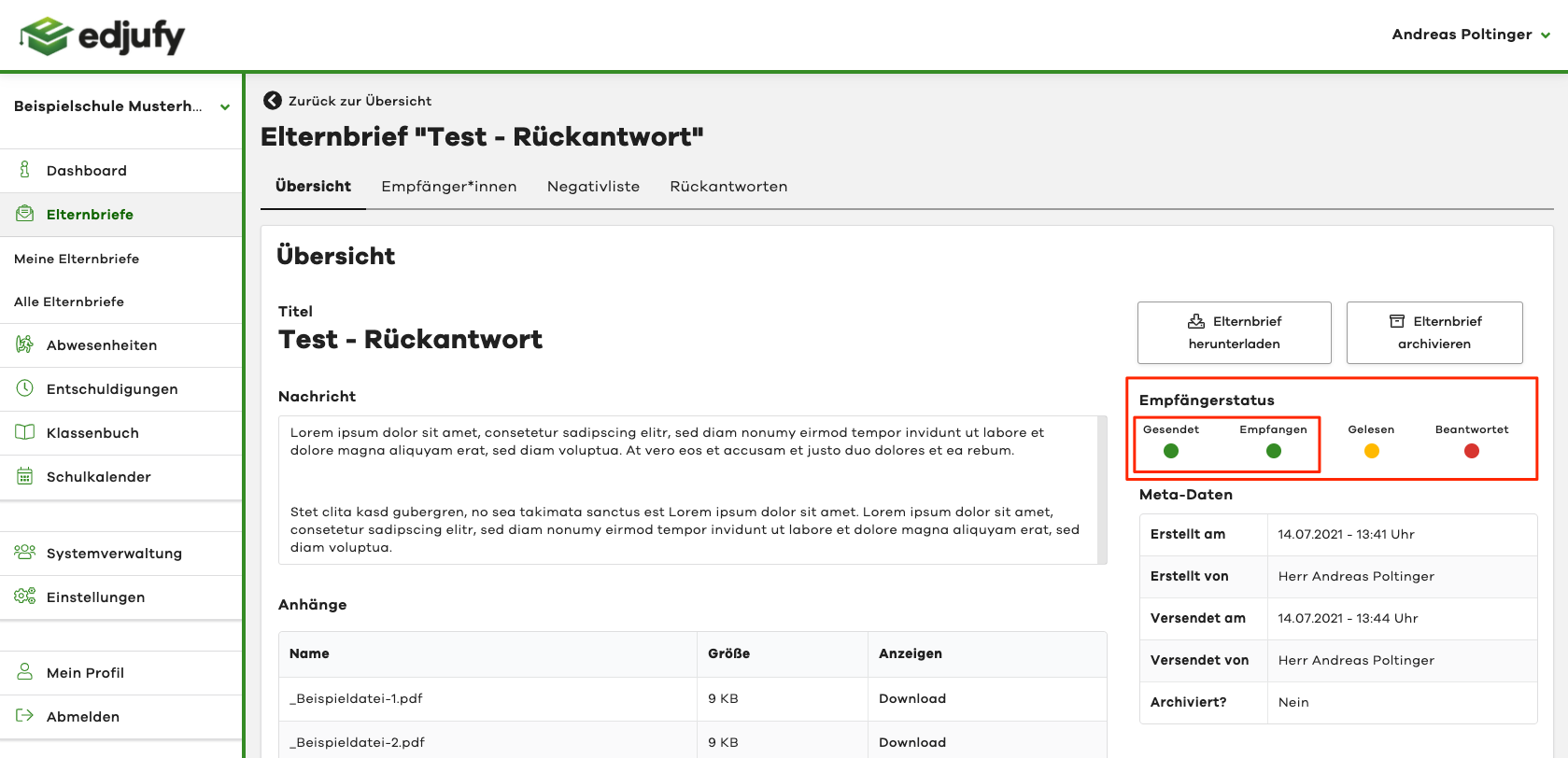
Meaning of the Colours
At the pupil level (the lowest level), we generally distinguish between the traffic light colours Green (sent, delivered, read, answered) and Red (not sent, not delivered, not read, not answered).
We inherit this information to the higher-level units (classes / grade levels / entire parent letter). For example, if all pupils within a unit are green, then the entire unit is naturally also green. Conversely, the traffic light colours of the units behave similarly with the colour Red. If there are several red and green values within a unit (e.g. for a class), the entire unit receives the colour Yellow.
For a better understanding, we would like to show you the following examples
Example 1
In the introduction to this chapter, we showed you the traffic lights of the entire parent letter. Let us now look at how this information is composed.
In class 1a, we have 4 pupils
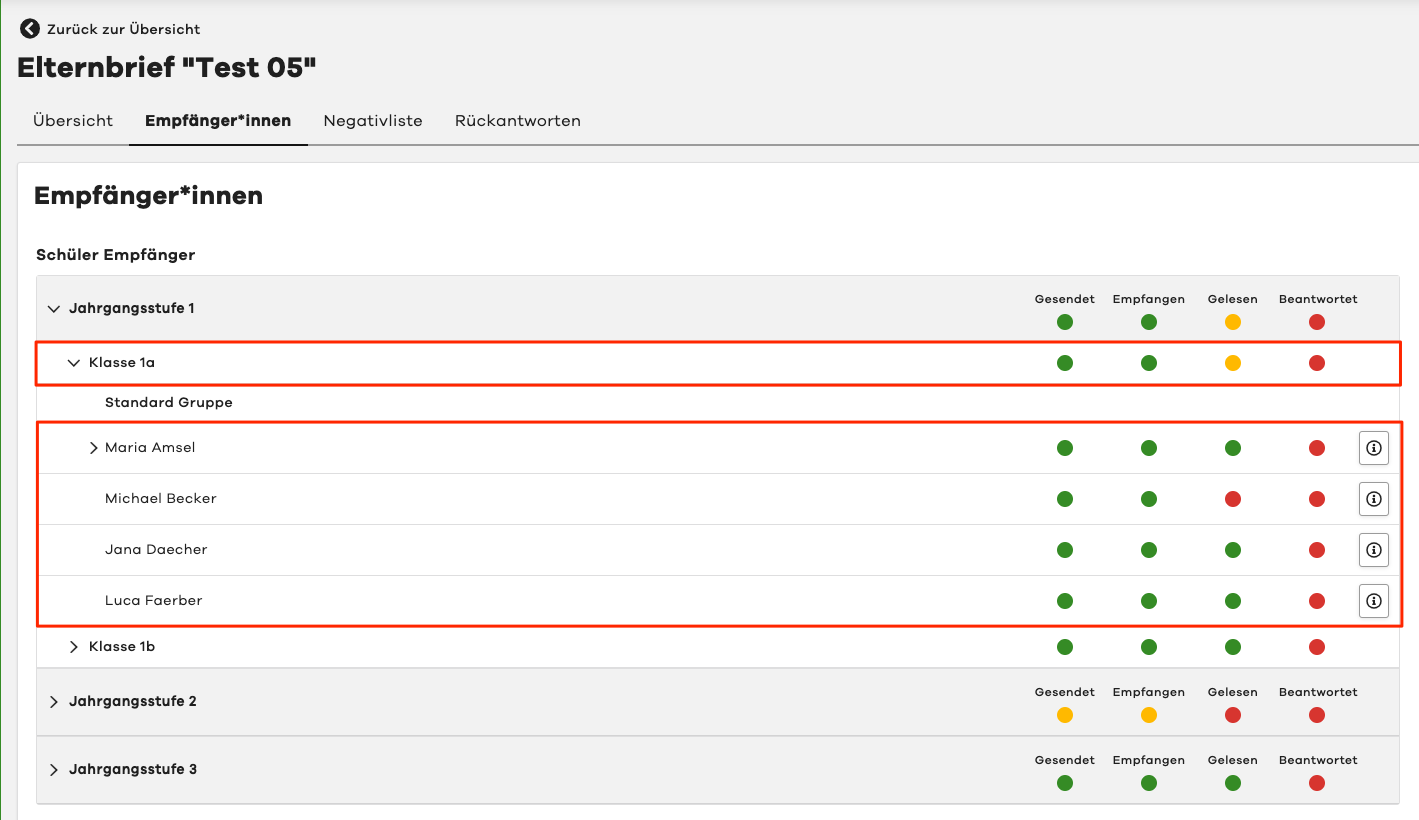
- The parent letter could be sent and delivered to all 4 pupils of class 1a
- This results in 4 green traffic lights for Sent and Received
- This means the higher-level unit (class 1a) receives the traffic light colour Green for Sent and Received
- 3 recipients have read the parent letter and 1 recipient has not
- This results in 3 green and one red traffic light
- This means the higher-level unit (class 1a) receives the traffic light colour Yellow for Read
- 4 recipients have (not yet) answered the parent letter
- This results in 4 red traffic lights
- This means the higher-level unit (class 1a) receives the traffic light colour Red for Answered
Example 2
In the introduction to this chapter, we showed you the traffic lights of the entire parent letter. Let us now look at how this information is composed.
In class 1a, we have 4 pupils
- The parent letter could be sent and delivered to all 4 pupils of class 1a
- This results in 4 green traffic lights for Sent and Received
- This means the higher-level unit (class 1a) receives the traffic light colour Green for Sent and Received
- 3 recipients have read the parent letter and 1 recipient has not
- This results in 3 green and one red traffic light
- This means the higher-level unit (class 1a) receives the traffic light colour Yellow for Read
- 4 recipients have (not yet) answered the parent letter
- This results in 4 red traffic lights
- This means the higher-level unit (class 1a) receives the traffic light colour Red for Answered